

|
Perhaps the only VC cliché worse than the “summer slow down,” is the VC who claims “we’re as busy as ever.”
Well, we’re going there…
The pace of our pipeline, our deals, and our overall ecosystem is certainly not in a summer lull. As we highlight below, we’re seeing industries change before our eyes, and entirely new industries being built at the same time.
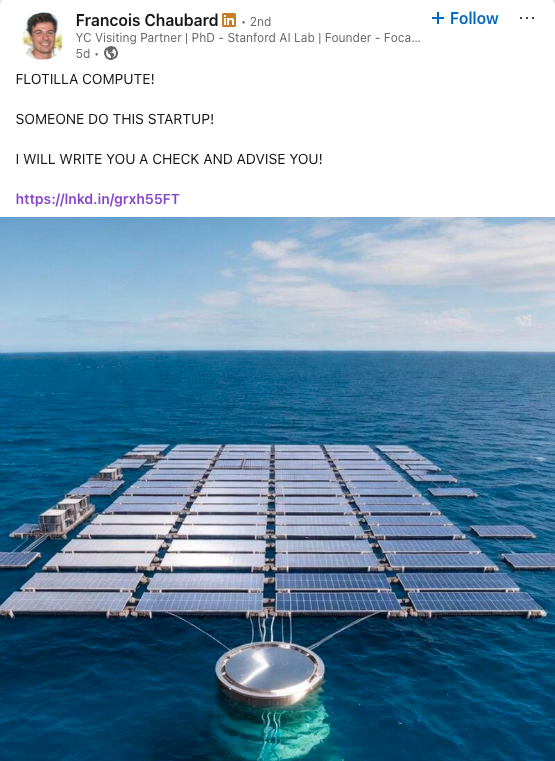
For example, we have seen a myriad of startups pitching "ocean data centers." And now Y Combinator said they want to fund “compute at sea.” Ocean data centers! Sensitive server racks in one of the harshest environments on the planet?
|
 |
|
But it’s not entirely crazy. Some of the approaches may be, but on first principles there’s a lot to like. Free energy (for those harnessing waves or the sun), free cooling, no fresh water needed, and they’re certainly not in anyone’s backyard (There are some whales and other wildlife who might have something to say here. Alas...).
So that’s why it’s not just startups attempting to build marine data centers. Famously, Microsoft attempted this way back in 2015 with Project Natick, but more recently, Samsung stepped into the race for compute. Samsung!
And here’s the thing the "let's put data centers in space" crowd can’t say: the ocean has a natural answer for the heat. Everyone’s excited about putting compute in orbit, but up there the only way to shed heat is to radiate it away, slowly, into the vacuum — which is its own engineering nightmare. In the ocean, the coolant is already all around you.
[Warning: Another famous VC cliché – shamelessly plugging portfolio companies. Here comes]… Propeller has two portfolio companies in this arena already: Aikido Technologies and Blue Energy. Both are working on speed to power for coastal communities/customers and/or... offshore data centers. We got to "Yes" on these companies because it was more than just "there's a lot to like." For starters, the founder/CEO's of both companies are stellar AND deeply experienced in their sectors. They know what it takes to build in this environment.
Additionally, we liked their speed to durable power. What we mean is that they may enable "speed to compute," but ultimately these are energy companies suited to the many demands on our grid (not just data centers).
Zooming back out to the wider 'ocean data center' ecosystem, and because other investors ask us all the time, here are a few of the top challenges to consider, or as Steven would put it, his "big bugaboos"...
|
 |
|
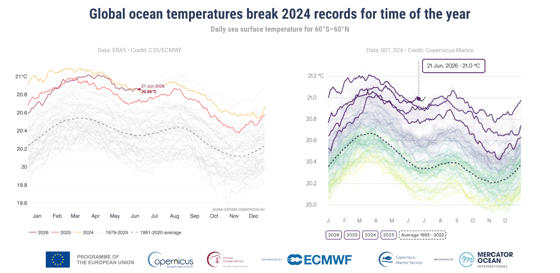
So what's our point? The point is that the ocean is heating up. Yes, unfortunately, it is literally warming before our eyes (see charts above). It's not good.
But metaphorically, too, the ocean is 'heating up' with startup activity. Why? Two reasons:
It feels busier than ever, and more competitive than ever, but it's a super exciting time to be investing! [Had to get one last VC cliché in there!]. It feels like Propeller's surface area continues to expand, and the quantity and quality of the entrepreneurs going after salty ideas is only rising. We can’t wait to see what this next wave of founders will do. |